


Bengaluru Traffic: 270-Km RRTS Network Planned To Connect Tumakuru, Mysuru, KGF
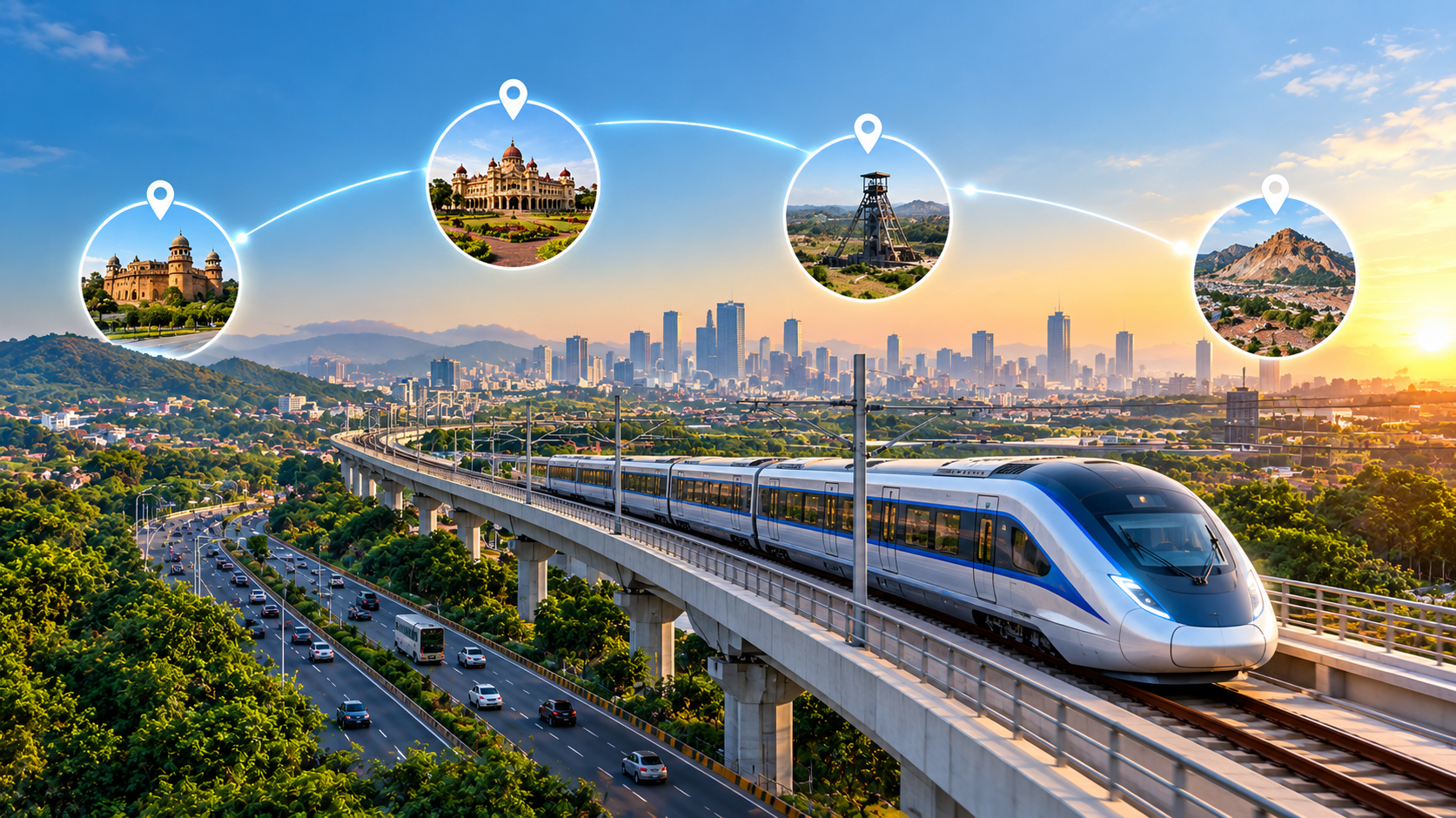
Bengaluru’s growth is no longer confined to the city’s traditional urban boundaries. As traffic congestion increases and housing and employment expand into surrounding areas, Karnataka is looking at a broader regional transport network to connect Bengaluru with emerging economic centres.
One of the major proposals now being discussed is a 270-km Regional Rapid Transit System (RRTS) connecting Bengaluru with Tumakuru, Mysuru and Kolar Gold Fields (KGF).
The proposal is part of a larger 10–15-year development roadmap for the Bengaluru Metropolitan Region. The plan also includes expansion of the Metro network, suburban rail connectivity, new ring-road infrastructure, industrial townships, affordable housing and improvements to water and sewage infrastructure.
For the real estate market, these proposals are important because better regional connectivity can gradually change where people live, work and invest.
What Is the Proposed 270-Km RRTS Network?
The Karnataka government is considering a 270-km RRTS network connecting Bengaluru with three major regional corridors:
- Bengaluru–Tumakuru
- Bengaluru–Mysuru
- Bengaluru–KGF
The proposal was discussed during a meeting chaired by Karnataka Deputy Chief Minister D.K. Shivakumar on October 5, 2026, as part of preparations for a comprehensive development plan for the Bengaluru Metropolitan Region.
The broader objective is to improve regional mobility and reduce pressure on Bengaluru’s congested core areas.
It is important to note that the RRTS network is currently part of the government’s long-term planning and proposal stage. Detailed alignments, stations, project costs, implementation timelines and execution arrangements have not yet been finalised.
Why Is Bengaluru Looking Beyond Its Existing Transport Network?
Bengaluru has expanded significantly over the past few decades. Employment centres, residential communities and industrial activity have increasingly moved towards the city’s outskirts and neighbouring districts.
This expansion has created a major transportation challenge.
People living outside the central city often travel long distances for work, education and business. At the same time, companies are increasingly establishing operations outside traditional commercial districts.
The proposed RRTS network is therefore being considered as part of a larger strategy to connect Bengaluru with surrounding urban and economic centres.
Instead of concentrating all growth within Bengaluru, regional transport could support a more distributed pattern of development.
Bengaluru–Tumakuru RRTS Corridor
The Bengaluru–Tumakuru corridor is particularly significant from a regional growth perspective.
Tumakuru has developed as an important industrial and manufacturing centre and is connected to Bengaluru through NH-48.
A faster regional rail connection could potentially improve accessibility between the two cities and strengthen their economic relationship.
For the real estate sector, improved connectivity can make locations between major employment centres more attractive to residents who are willing to live farther from the city core in exchange for better access to employment hubs.
However, the actual impact will depend on the final RRTS alignment, station locations and implementation timeline.
Bengaluru–Mysuru RRTS Corridor
Mysuru is one of Karnataka’s major urban centres and has an established residential, educational, tourism and technology ecosystem.
A dedicated regional rapid transit connection could provide another high-capacity transport option between Bengaluru and Mysuru.
If implemented, such a connection could encourage stronger economic interaction between the two cities and potentially support development around future transit nodes.
For property buyers, this highlights an important real estate principle: connectivity should be evaluated at both the city and regional level.
Bengaluru–KGF RRTS Corridor
The proposed Bengaluru–KGF corridor would extend regional rapid transit towards the Kolar Gold Fields region.
KGF and the wider Kolar district are part of Bengaluru’s broader eastern regional growth story.
Improved public transport could potentially strengthen connections between residential areas, employment centres and industrial zones along the corridor.
Again, the RRTS proposal should not be treated as an immediate property-price trigger. Buyers should wait for more information about the final alignment, stations and implementation before making location-specific assumptions.
Metro Network Also Planned to Expand
The RRTS proposal is only one part of Karnataka’s larger transportation strategy.
The government is targeting an expansion of Bengaluru’s Metro network to 312 km by 2037, compared with roughly 96 km currently.
The government is also looking at an additional 72 km of suburban rail connectivity and new road infrastructure to improve movement around Bengaluru.
Together, Metro, suburban rail and RRTS could serve different layers of the transportation network:
Metro: Primarily intra-city movement
Suburban rail: Longer-distance travel within the Bengaluru region
RRTS: Faster regional connections between Bengaluru and surrounding cities
This type of layered transport system could become increasingly important as Bengaluru’s metropolitan footprint expands.
Proposed Ring Roads Could Reshape Bengaluru’s Outskirts
Alongside rail infrastructure, the government is also discussing additional road connectivity.
A proposed ring-road network would connect more hubs around Bengaluru, while the plan includes linking Peripheral Ring Road Phase 2 with NICE Road.
Recent reporting puts the proposed ring-road network at around 210 km, although details remain part of the broader planning exercise.
For real estate, ring roads can be significant because they improve access between peripheral locations without requiring every journey to pass through the city centre.
This could support the emergence of new residential and employment clusters around Bengaluru’s outer areas.
Nine New Industrial Townships Planned
Transport development is being planned alongside industrial expansion.
The Karnataka government has outlined plans for nine integrated industrial townships across the Bengaluru Metropolitan Region.
Around 7,900 acres have already been acquired, while acquisition of another approximately 5,600 acres is underway, taking the identified land requirement to around 13,500 acres.
The idea is to combine employment, infrastructure and supporting urban development instead of concentrating economic activity within Bengaluru’s existing core.
This could have an important long-term impact on the regional real estate market.
Where employment centres expand, demand for nearby housing, rental properties, retail and supporting services can also develop over time.
AI City and AI University Could Add Another Growth Layer
The state’s development roadmap also includes plans for an AI City, with the government proposing to model it on Singapore’s Punggol.
Officials have also been directed to identify land for a proposed AI university.
If these initiatives progress, they could add another technology-focused employment cluster to Bengaluru’s wider metropolitan region.
For the real estate market, the important factor will be where these developments are eventually located and how effectively they connect with existing transport networks.
What Does This Mean for Bengaluru Real Estate?
Large infrastructure proposals can influence real estate in several ways.
1. Better regional accessibility
If RRTS corridors are eventually implemented, people could potentially consider living farther from Bengaluru’s core while maintaining access to major employment centres.
2. Growth around future transit nodes
Locations around confirmed stations can become more attractive for residential and commercial development.
However, buyers should distinguish between proposed stations and officially confirmed stations.
3. Expansion of employment corridors
Industrial townships, technology clusters and business districts can create new employment centres outside established Bengaluru locations.
4. Greater demand for peripheral housing
As employment becomes more distributed, peripheral residential areas could become increasingly relevant to homebuyers.
5. More opportunities for plotted developments
Long-term regional expansion can also increase interest in plotted developments in growth corridors where infrastructure and employment are developing.
What Does the RRTS Plan Mean for North Bengaluru?
Although the currently discussed RRTS corridors specifically mention Tumakuru, Mysuru and KGF, the larger BMR development strategy is important for the entire Bengaluru metropolitan region.
North Bengaluru is already experiencing significant infrastructure and real estate activity around Devanahalli, the airport corridor, Aerospace Park and surrounding areas.
Developments such as Assetz City of Palms and Assetz Codename Palmscape reflect the growing interest in plotted communities in the Devanahalli and IVC Road region.
For buyers researching North Bengaluru, the broader infrastructure story should be considered alongside individual project factors such as location, approvals, connectivity, development stage and amenities.
Devanahalli and the Larger North Bengaluru Growth Story
Devanahalli is already one of the major residential and infrastructure growth corridors around Bengaluru.
The area benefits from its proximity to Kempegowda International Airport, Aerospace Park, NH-44 and other regional infrastructure.
Olive Homes currently features multiple property options in and around this growth corridor.
For example, Purva Tivoli Hills is a large plotted development in Devanahalli, while Assetz Codename Palmscape is an upcoming plotted development on IVC Road. These projects represent different options for buyers evaluating plotted property in North Bengaluru.
The key takeaway is that buyers should look at the complete infrastructure ecosystem, rather than relying on a single proposed transport project.
6–6.5 Lakh Affordable Homes Planned
Housing is another major component of the state’s long-term BMR development strategy.
The government is planning approximately 6 lakh to 6.5 lakh houses, including housing for around 40,000–50,000 industrial workers.
This is intended to support the growing workforce associated with industrial and economic expansion across the region.
The combination of employment, transport and housing is important because sustainable regional growth requires all three to develop together.
Water and Infrastructure Will Be Just as Important
Transport alone cannot determine the success of Bengaluru’s future expansion.
The Bengaluru Metropolitan Region is expected to require approximately 3,600 million litres of water per day by 2037, according to the government’s planning discussions.
The proposed roadmap therefore includes wastewater recycling, lake rejuvenation, drinking-water infrastructure and sewage-management improvements.
For real estate buyers, this is an important reminder.
When evaluating an emerging location, connectivity should not be the only consideration.
Water availability, sewage infrastructure, roads, schools, healthcare, employment and civic services are equally important for long-term liveability.
Should You Buy Property Because of the Proposed RRTS?
Not necessarily.
A proposed infrastructure project can indicate a potential long-term development direction, but it should not be treated as a guaranteed increase in property prices.
Before buying a property based on an upcoming transport project, buyers should check:
- Whether the project has received the necessary approvals
- Whether the proposed alignment is officially confirmed
- Distance from the property to the proposed station
- Current road and public transport connectivity
- Existing employment centres nearby
- Water and civic infrastructure
- Project approvals and RERA status
- Current property pricing
- Development timeline
- Actual demand in the surrounding locality
This approach helps separate real infrastructure advantages from speculative future expectations.
Bengaluru’s Growth Is Moving Towards a Regional Model
The proposed 270-km RRTS network is part of a much larger change in the way Bengaluru’s future growth is being planned.
Instead of relying entirely on the existing city core, Karnataka’s long-term strategy is focused on connecting Bengaluru with surrounding cities, developing new employment centres and improving infrastructure across the wider metropolitan region.
The combination of RRTS, Metro expansion, suburban rail, ring roads, industrial townships, housing and social infrastructure could gradually create a more connected regional economy.
For the real estate market, this could mean that the next phase of Bengaluru’s growth will increasingly be shaped by regional connectivity and employment corridors.
Conclusion
The proposed 270-km RRTS network connecting Bengaluru with Tumakuru, Mysuru and KGF is one part of Karnataka’s broader 10–15-year vision for the Bengaluru Metropolitan Region.
Alongside the RRTS proposal, the government is planning major Metro expansion, suburban rail improvements, ring-road connectivity, industrial townships, affordable housing and stronger civic infrastructure.
For property buyers, the most important takeaway is not simply the proposed RRTS itself. It is the broader shift towards planned regional development around Bengaluru.
As infrastructure and employment expand beyond the traditional city limits, locations across Bengaluru’s peripheral and regional growth corridors could become increasingly important.
However, buyers should evaluate each property based on confirmed infrastructure, current connectivity, project approvals, pricing and actual development progress rather than relying solely on future proposals.
Contact us