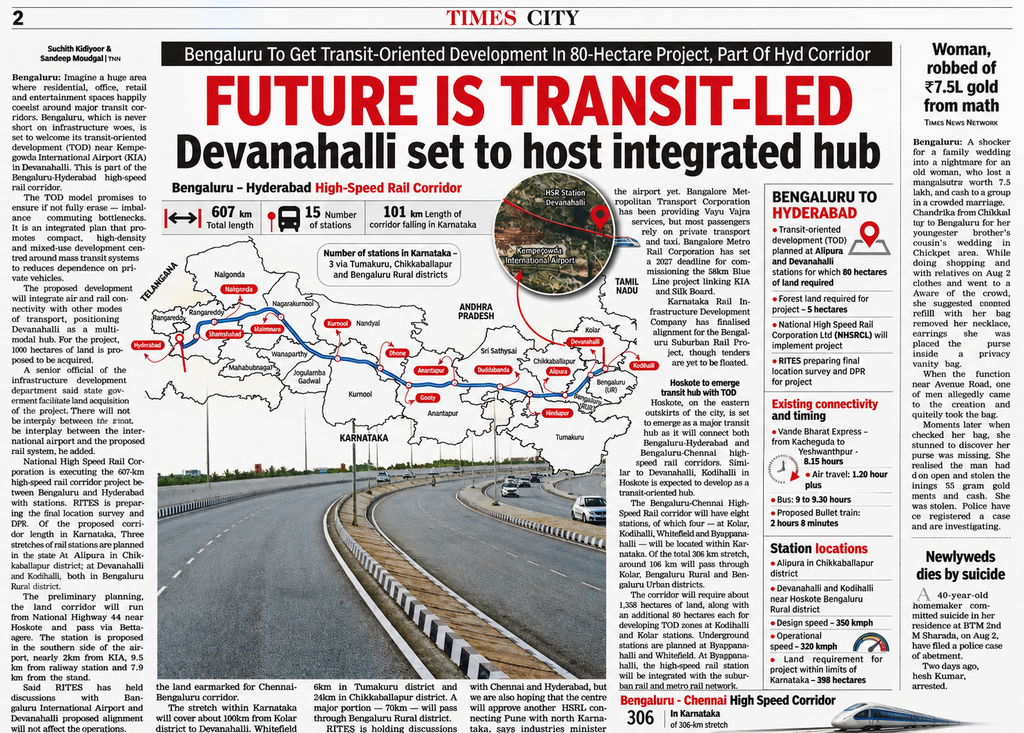


Future Is Transit-Led: Devanahalli Set to Host Integrated Hub in Bengaluru’s 80-Hectare TOD Project
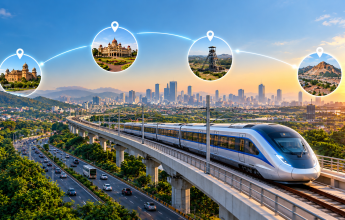
Bengaluru’s northern growth story is set to enter a significant new phase, with Devanahalli emerging as a key destination for a large-scale transit-oriented development (TOD) project. The proposed 80-hectare integrated development is expected to strengthen connectivity between Bengaluru, Kempegowda International Airport and the Bengaluru–Hyderabad high-speed rail corridor.
As Bengaluru continues to expand beyond its traditional urban boundaries, the focus is increasingly shifting towards integrated mobility, planned infrastructure and high-density development around major transport networks. The Devanahalli project represents an important step in that direction.
A Major Transit-Oriented Development for North Bengaluru
The proposed project is planned around the upcoming Bengaluru–Hyderabad High-Speed Rail Corridor and is expected to be developed as a multi-modal transit hub.
Transit-oriented development is a planning model where residential, commercial, retail and public infrastructure are developed around major transportation systems. The objective is to reduce dependency on private vehicles while improving accessibility through rail, road and public transport connectivity.
The Devanahalli development is expected to benefit from its strategic location near:
- Kempegowda International Airport
- The proposed Bengaluru–Hyderabad High-Speed Rail Corridor
- Bengaluru Metro connectivity
- Major road and highway networks
- Existing and emerging commercial developments in North Bengaluru
The proposed development could therefore transform Devanahalli from an airport-centric growth destination into a major integrated transportation and economic hub.
Bengaluru–Hyderabad High-Speed Rail: A Strategic Corridor
The Bengaluru–Hyderabad High-Speed Rail Corridor is expected to cover approximately 607 kilometres and connect several important cities and districts across Karnataka, Andhra Pradesh and Telangana.
The Karnataka section is expected to include key locations such as:
- Bengaluru
- Devanahalli
- Chikkaballapur
- Kolar
- Tumakuru
- Other important transit points along the corridor
The proposed alignment would significantly improve inter-city connectivity while creating new opportunities for urban development around major stations.
For Bengaluru, the project is particularly significant because it could provide faster connectivity between the city, the airport region and major growth centres in northern Karnataka.
Devanahalli’s Transformation Beyond the Airport
For several years, Devanahalli’s growth has largely been associated with Kempegowda International Airport. However, the proposed transit-oriented development could introduce a completely new dimension to the region.
Instead of being viewed only as an airport corridor, Devanahalli has the potential to evolve into a self-sustaining urban ecosystem supported by:
- High-speed rail
- Metro connectivity
- Road infrastructure
- Commercial development
- Hospitality projects
- Residential communities
- Retail and entertainment spaces
- Public infrastructure
The development of an integrated hub could also attract businesses and institutions looking to establish operations outside Bengaluru’s increasingly congested central and eastern corridors.
80 Hectares of Integrated Development
The proposed project is expected to require around 80 hectares of land, with a smaller portion identified as forest land.
The development is likely to be planned around the principle of creating a compact, high-density urban environment where people can live, work and access transportation within a closely connected ecosystem.
Such a model could help reduce travel distances and improve the efficiency of public infrastructure.
The integration of residential and commercial developments with high-capacity transportation networks could also create new opportunities for real estate growth in the Devanahalli region.
A Multi-Modal Transportation Hub
One of the most important aspects of the project is its potential integration with multiple transportation systems.
The proposed Devanahalli transit hub could connect:
- Bengaluru Metro Rail
- High-Speed Rail
- Airport connectivity
- Road transport
- Bus services
- Future regional transportation systems
This type of integration is becoming increasingly important for large cities such as Bengaluru, where traffic congestion and long commuting distances remain major challenges.
A well-planned multi-modal hub could enable passengers to move seamlessly between different modes of transportation, reducing travel time and improving accessibility.
Faster Connectivity Could Change Travel Patterns
The proposed Bengaluru–Hyderabad High-Speed Rail Corridor is expected to significantly reduce travel time between major cities along the route.
Currently, travel between Bengaluru and Hyderabad by road can take several hours, while train travel also involves a long journey.
High-speed rail infrastructure could substantially reduce the overall travel time and make inter-city commuting more efficient.
This could also create new possibilities for:
- Business travel
- Regional tourism
- Corporate expansion
- Inter-city workforce mobility
- Development of satellite cities
- Growth of industrial and technology corridors
Devanahalli could benefit significantly from this shift because of its position between Bengaluru’s expanding northern corridor and the airport region.
A Boost for Real Estate and Commercial Development
Major transportation projects have historically influenced property markets by improving accessibility and attracting investment.
The proposed transit-oriented development could increase demand for:
- Residential apartments
- Premium housing
- Commercial office spaces
- Hotels
- Retail spaces
- Warehousing and logistics facilities
- Mixed-use developments
However, the larger opportunity lies beyond property appreciation. The real transformation could come from the creation of a planned urban ecosystem supported by reliable public transportation.
As Bengaluru continues to grow, locations with strong infrastructure and multi-modal connectivity are likely to become increasingly important for businesses, residents and investors.
Devanahalli Could Emerge as a Major Urban Centre
The proposed project could accelerate Devanahalli’s transition into one of Bengaluru’s most important growth destinations.
The region already benefits from:
- Proximity to the international airport
- Expanding road infrastructure
- Industrial and business activity
- Aerospace and technology developments
- Large land parcels
- Increasing residential demand
The addition of high-speed rail and an integrated transit-oriented development could further strengthen its position.
Instead of functioning as a peripheral extension of Bengaluru, Devanahalli could gradually develop into an independent urban centre with its own commercial, residential and transportation ecosystem.
The Bigger Picture for Bengaluru
Bengaluru’s future growth cannot depend entirely on existing central business districts and already congested neighbourhoods.
The development of new urban centres connected through efficient transportation infrastructure will be critical to managing the city’s long-term expansion.
Transit-oriented developments around major transport corridors could help distribute economic activity more evenly across the region.
The proposed Devanahalli project therefore represents more than just real estate or infrastructure development. It could become part of a larger strategy to build a more connected, decentralised and sustainable Bengaluru.
Looking Ahead
The proposed 80-hectare transit-oriented development at Devanahalli could become one of the most significant infrastructure-led urban developments in North Bengaluru.
With the Bengaluru–Hyderabad High-Speed Rail Corridor, airport proximity, Metro connectivity and planned mixed-use development, the region has the potential to become a major transportation and economic gateway.
While the project will require careful planning, land acquisition and infrastructure coordination, its long-term impact could reshape how Bengaluru expands towards the north.
For Devanahalli, the future may no longer be defined only by the airport.
The next phase of growth could be driven by something even bigger — integrated connectivity, high-speed mobility and a new generation of transit-led urban development.
Contact Us
Source
Times of India